Evaluate the clarity of your goals
Clear goals are essential to maintain motivation and guide action effectively. The clarity of the objective directly influences cognitive, emotional, and behavioral consequences.
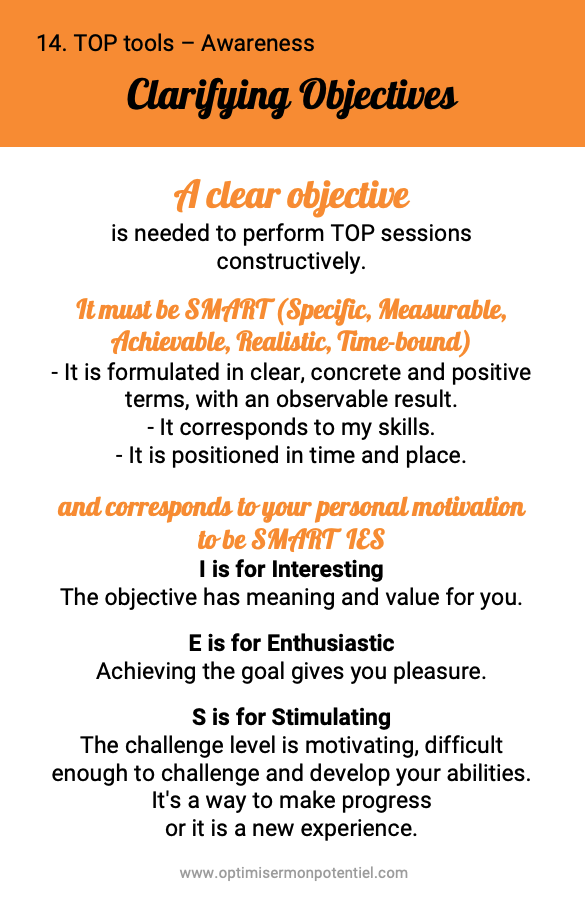
SMARTIES criteria revisited
- Sspecific: Precise and detailed, unambiguous
- Mmeasurable: Quantifiable and verifiable
- Aachievable: In line with its resources
- RRealistic: In line with its values, basic needs and priorities
- TTime-bound: Time-bound with deadlines
Add:
- IInteresting: What is the meaning, the value of this objective for me?
- EEnthusiastic: What pleasure do I have in achieving this goal?
- SStimulant: What is my motivation level?
Motivational determinants
The duration
- Short-term goals : more motivating
- Long-term goals : require a division into intermediate objectives
Time limits affect:
- Prioritization : Force to identify critical tasks and eliminate distractions
- Focus : Less time = less multitasking so increased concentration
- Avoid perfection : Delivering work that is “good enough” rather than looking for perfection”
Proximity
- Closer goals: stronger motivation
- Distant goals: need for intermediate steps
Questions to clarify
- What exactly do I want to achieve?
- How will I know if I have succeeded?
- Why is it important to me?
- When do I want to reach it?
- What are the intermediate steps?
- What resources do I need?
Clarity scale (0-10)
- 0-3 : Blur lens, wave
- 4-6 : Objective partially defined
- 7-8 : Clear and structured objective
- 9-10 : Perfectly defined objective
Add a note by clicking on the button below. 👇








.png)


.png)
.png)