
Mentally repeat a gesture, a sequence or a complete activity in a relaxed state to get energized and ready for action. This dynamization technique uses mental imagery.
Mental repetition activates the same brain areas as real action. It improves performance without physical fatigue.
It is a dynamization technique that consists of mentally repeating, in a relaxed state, until it is well executed:
The most effective sensory modalities are the visual and kinesthetic modalities. For auditors, it may be interesting to associate a sound (related to the activity) or music with the visualization and experience of an action. Visuals can do this exercise after watching the video of an expert (see video in attachment) or of themselves perfectly performing the gesture.
Imaging work can take several forms:
In practice, the choice of one or other of the modalities (alone or in combination) will depend on the objectives and the activity: an athlete can devote fifteen minutes to imagining a precise gesture of a few seconds or 5 minutes for a complete action. However, it will always be necessary to end with a timed Mental Repetition (analytical or sequential for a long-lasting action) since the subject will tend to reproduce what he imagined.
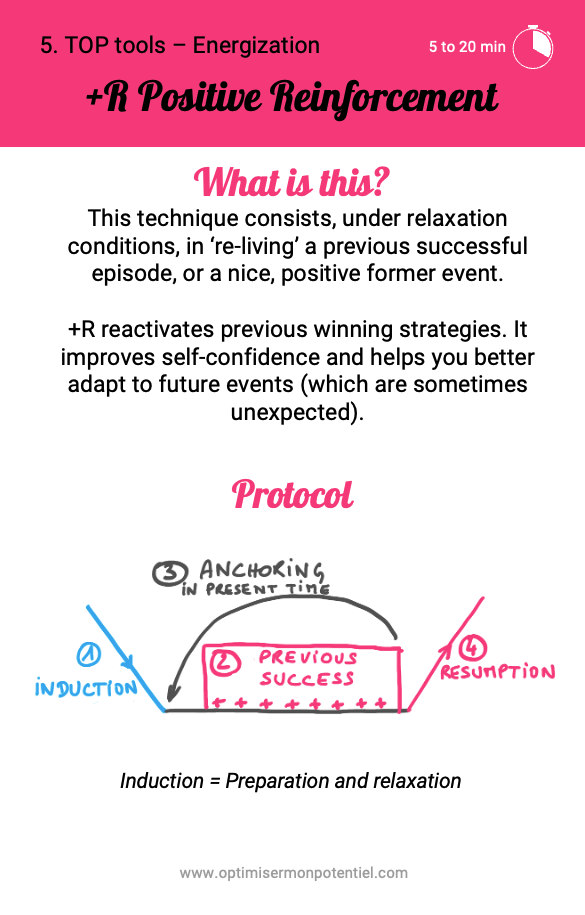
The protocol follows a structured anchoring cycle:
Imagine the action mentally and perfectly successful, each movement and/or each gestural sequence and/or the test in its totality.
The repetition will be external for the visuals or for working this modality in others. It will be internal for kinesthetics or to develop it. The ideal is to use both modalities. A positive internal dialogue may be included (detailed description of actions, motivation).
It is a question of bringing back “here and now” all the positive ideas and then letting go (the unconscious and the reflexes put in place).
With training, subjects will find that imagining an action positively will encourage them to perform it perfectly.
Important rule : Always end with a real speed MR (partial or total)
Duration: 5 to 20 min
The subject is in the action to be taken and he mentally starts again, better if necessary, an action that he actually carried out before. This therefore requires a minimum of knowledge on the skill to develop such as the video allowing you to practice making a bow tie in order to be able to mentally redo it.
It is also important to work in the tempo of the gestures to be performed at the end of the exercise when the MR is done at a slow or accelerated pace because the brain will be conditioned to this rhythm.
Like any session involving relaxation, it should be done well before an activity because of possible hypovigilance.





.png)


.png)
.png)