A mental imagery technique that allows you to organize and optimize your resources to achieve your goal in a relaxed state. It allows you to approach an objective by optimizing your resources and organization.
The MAS uses the brain's ability to anticipate and prepare. In a relaxed state, the brain can program strategies for success more effectively.
Mental Anticipation of Success (MAS) is an essentially dynamization technique that allows you to approach any situation positively and in full possession of your means, especially if it is experienced as stressful.
The term “anticipation” was chosen because the subject anticipat himself mentally into the future to imagine the success of his objective. This word can be replaced by that of “programming” because it is also a question of setting up a program of actions to be carried out in order to carry out an activity successfully.
Mental Anticipation of Success therefore corresponds to a more or less long-term expectation of a perfectly carried out action. You can prepare for the next day's action as well as for the one that will take place in several months. In the latter case, intermediate goals will have to be positively “programmed” because their success will not only make it possible to reach the final objective, but will create positive reinforcement. This will give confidence in the method at first (“It works! ”) and then, above all, will develop self-confidence (“I can do it! ”).
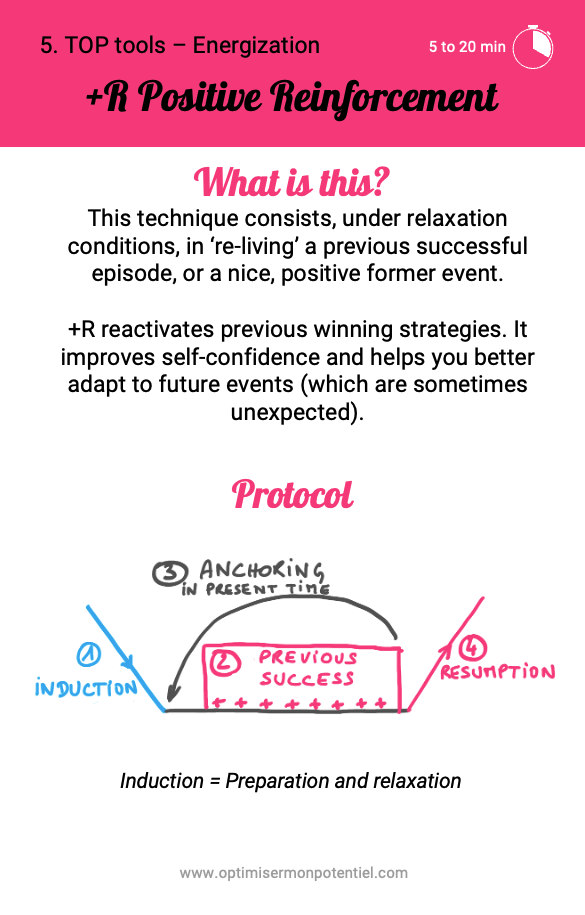
The protocol follows a structured anchoring cycle:
(We recommend using the SMARTIES method, see video...)
Duration: 5 to 20 min
The main indications for MAS are motivation and stress management.
MAS is the preferred technique for motivating yourself, re-motivating yourself and preparing yourself positively for an action. It will be necessary to emphasize the feeling of competence (“you imagine that you have succeeded and how you are doing to succeed”, giving feedback) and the feeling of free choice (it is the subject who imagines how he is organized, what actions he will have to do to reach his goal...). MAS plays a key role in setting goals and is an integral part of the six-step motivational process model.
MAS acts on the representation that the subject has of himself and of the situation he is (or will be) confronted with. It makes it possible to de-dramatize the situation.
Indeed, the subject imagines that he has succeeded (but for the unconscious it is as if it had been really successful) and all the means he must implement to succeed (he knows how to do it). So the situation seems quite surmountable. MAS is therefore one of the techniques for strengthening self-confidence and assertiveness. It allows you to “start winning”.
Like all TOP techniques, it develops attention and the power of concentration. It is therefore interesting for optimizing learning. It is therefore part of the toolbox for preparing for exams, sports competitions and all professional or fun activities.
With training, MAS teaches everyone to take care of and assume responsibility for themselves, and therefore to be autonomous and responsible.
MAS is used to improve sleep quality by focusing mental imagery on the activities of the next day. It also promotes personality structuring in young people.
We therefore note that this technique allows both to be energized and to regulate oneself for a short (tomorrow), medium (one week) or long (six months) term objective and, as it is carried out in a state of relaxation (physical and mental) it promotes immediate recovery.
While MAS represents a technique of choice to be proposed as soon as possible, it requires the subject to know how to relax and easily access mental imagery.
Like any session involving relaxation, it should be done well before an activity because of possible hypovigilance.





.png)


.png)
.png)