What is it?
A psychological recovery technique that, once developed, can be used alone or integrated into relaxation (RS or R3P).
The ID will correspond to preferential sensory modalities: visuals will see “objects” (color, elements of nature, characters...), auditors will hear relaxing music, pleasant sounds, kinesthetics will experience sensations of relaxation (lightness, heaviness, cotton, well-being, serenity...). Some will use multiple sensory channels.
The different types of relaxing image:
The Image of Relaxation can be uni- or multi-sensory, correspond to reality or be imaginary:
- uni-sensory : to see a color, to hear a music, to smell a flavor, to smell a perfume or to experience a sensation.
- multi-sensory : situation in which the subject sees objects, colors, characters, hears pleasant sounds and music, feels relaxed, perceives pleasant scents and flavors.
- Real image : memory of the last vacation, of a card game in childhood, the favorite color, the music usually listened to to to relax, the sensations experienced in pleasant circumstances.
- Imaginary image : the vacation you would like to spend in the Polynesian sun, the house of your dreams... This imaginary image can consist of several real images; for example, if a person enjoys the sea and the mountains, they can create a landscape with the sea at the foot of the mountains.
Development protocol
Preparatory phase
- Installation : “I'm settling in as comfortably as possible” Close my eyes or not
- Weather TOP : What is my internal state?
- Intent : Why am I doing this exercise?
- Environment : “I take into account my environment with all the noises that could occur if these noises are not available, I will stay focused on my internal state”
- Respiratory exercises in order to accentuate the state of relaxation
Work phase
- Once the subject is in a good state of relaxation, one can begin the exercises of the technique:
- Let your ID come by using VAKOG (colors, music, music, scents, flavors, sensations...), the internal dialogue. It's about reviving the subject's relaxing elements through suggestions. In an individual session, the practitioner may ask for details concerning his Image in order to describe it to him as concretely as possible, which will facilitate relaxation, if necessary. However, you will always have to work with the perspective of making the subject autonomous, so the best thing is to be “out of focus” as quickly as possible.
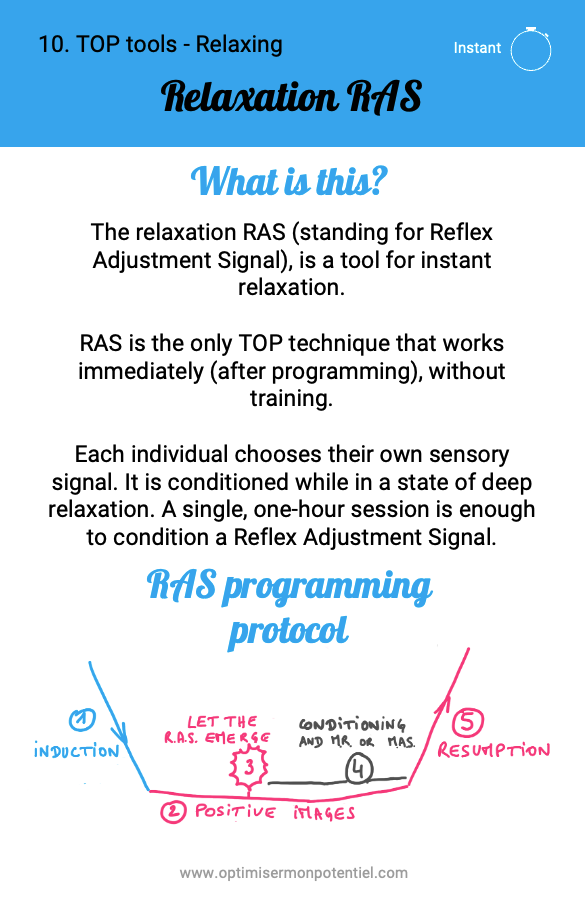
- Anchor phrase (if you want the Image of Relaxation to be a reflex adjustment signal to relax).
Psycho-physiological recovery
- If in line with the original intention
Duration: 5 to 20 min
Precaution:
Like any session involving relaxation, it should be done well before an activity because of possible hypovigilance.
Add a note by clicking on the button below. 👇



.png)


.png)
.png)